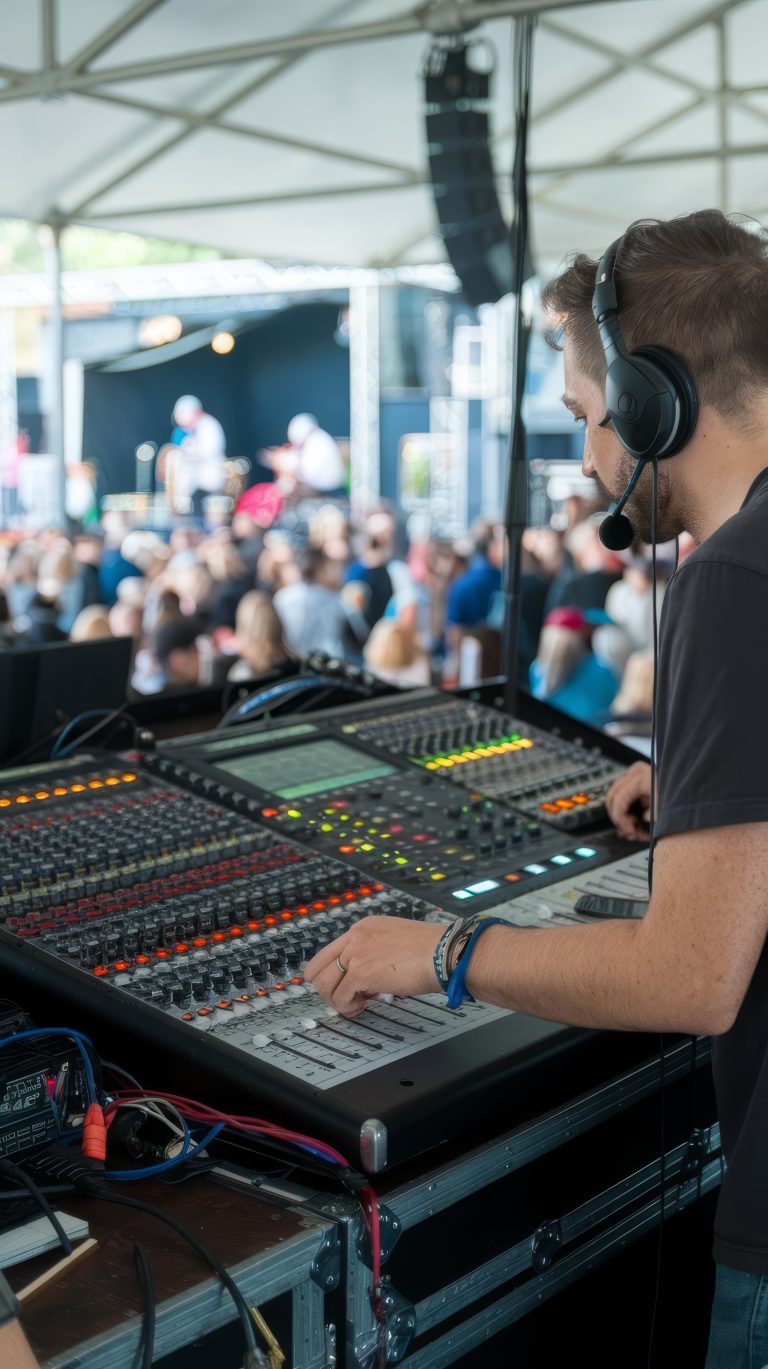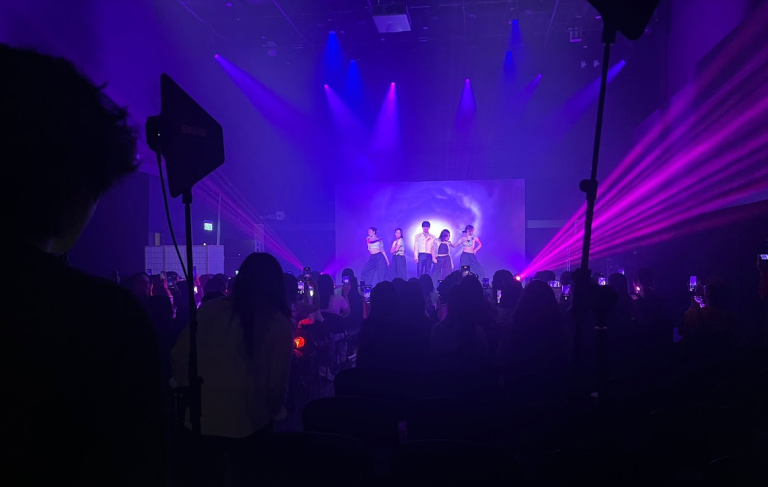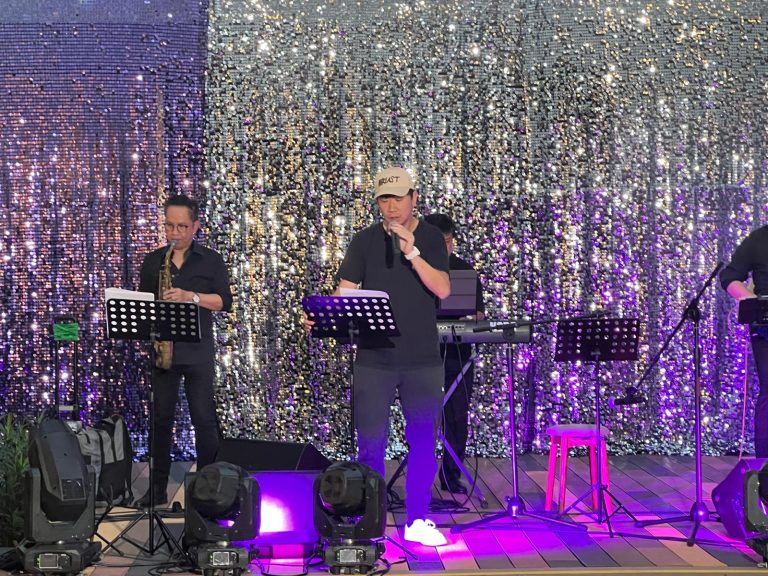


Sound hire requirements differ drastically across Singapore events, determined largely by event scale and venue type. A key distinction to bear in mind when engaging Singapore professional sound rental providers is whether your event is held indoors or outdoors.
Indoor Banquet Sound Rental & Acoustic Considerations
Many hotel ballrooms across Singapore, including Marina Bay Sands and Suntec City, feature carpeted floors and acoustic wall panelling. Carpets, upholstered seating and fabric wall treatments absorb high-frequency sound substantially. This often renders speech unintelligible for audience members seated towards the back of the room. Most functions hosted in hotel ballrooms feature keynote speakers and emcees relying on vocal clarity. Critical speech information sits within the mid-to-high frequency range (2kHz–5kHz), covering consonants such as s, t and k. When these frequencies are absorbed, audio comes across overly muted and bass-heavy to listeners. This acoustic challenge requires targeted audio tuning.
For this reason, securing on-site technical support from your sound rental vendor is strongly recommended. A professional sound engineer can fine-tune speaker microphones via the mixing console, boosting relevant frequency bands by 2–3 dB to recover consonant definition lost to carpet absorption. For wider banquet halls, further audio refinement can be achieved by installing side fill loudspeakers along the mid-to-rear sections of the venue, calibrated with precise millisecond-level audio delay.
Outdoor Venues: Professional Sound Systems for Events
Events held at open-air spaces such as The Promontory@Marina Bay operate under entirely different acoustic conditions. With no surfaces for sound reflection, audio dissipates rapidly over distance. Line array loudspeakers with high power output are therefore essential.
Line arrays consist of multiple loudspeaker cabinets rigged closely together, generating cylindrical wavefronts that disperse widely horizontally while maintaining tight vertical coverage. Audio attenuation is minimal with this setup: volume drops by only 3 dB every time distance doubles, ensuring consistent audibility for audiences further away.
Venues along the waterfront at Marina Bay also present unique environmental challenges: high humidity and frequent shifting winds. Variable wind conditions disrupt conventional high-frequency sound propagation and degrade audio quality. Thanks to their directional coverage design, line arrays deliver superior penetration against wind noise and atmospheric sound absorption.
Take a concert held at The Promontory@Marina Bay as a practical example. A professional sound contractor would deploy the following configuration: Aluminium lighting trusses erected to 6–8 metres on both sides of the stage, with 8 line array cabinets suspended per truss. Two smaller sound towers are positioned roughly 40 metres from the stage on either side of the lawn, each rigged with 2–4 fill line array units. Subwoofers are placed across the front of the stage in a cardioid polar pattern, enabling seamless event delivery.
Tailor Sound System Design to Venue Geometry
In summary, event planners must design main loudspeakers, fill speakers and subwoofer setups rationally based on venue dimensions and seating layout.
Main loudspeakers form the backbone of any audio system, delivering primary sound coverage and establishing directional imaging. Fill speakers are deployed to balance audio levels evenly across the entire audience area.
Front fill speakers primarily serve VIP guests seated in the first one or two rows immediately adjacent to the stage. Many concerts mount compact front fill cabinets along the stage lip. For instance, I previously managed a 500-delegate conference within a Singapore EXPO exhibition hall spanning 50 metres in depth. The sound engineer installed a second tier of delay fill speakers. Around 70 milliseconds of signal delay was programmed via a digital audio processor to boost coverage without creating audible echo.
Side fill speakers resolve uneven audio towards the venue flanks. High-directivity main loudspeakers suffer from limited horizontal dispersion. A large gala dinner held within the grand ballroom at Suntec Singapore Convention & Exhibition Centre, for example, spans a wide seating footprint. Beyond main stage loudspeakers, side fill cabinets are mandatory along both sides of the space.
II. Wireless Frequency Bands and Local Regulatory Compliance
- Singapore’s Infocomm Media Development Authority (IMDA) enforces strict regulations governing radio spectrum usage. The 703MHz – 803MHz band has been reallocated to local telecommunications operators including Singtel, StarHub and M1. All wireless microphones supplied by rental companies must operate within legally permitted frequency bands in Singapore. Numerous older wireless microphone units manufactured before 2018 still operate on the 700MHz or 800MHz bands and cannot be used legally.
Permitted UHF Band (470MHz – 698MHz): Professional wireless microphones complying with IMDA TS SRD standards must operate within the designated 470.00MHz – 698.00MHz UHF spectrum, with effective radiated power (ERP) capped at 10 mW. Rental Verification Checklist: When sourcing equipment from Singapore sound rental firms, confirm devices carry valid IMDA compliance labelling or are sourced from authorised distributors. Relevant band variants include Shure H5/J3/L4 and Sennheiser Range A/B/G.
- Multiple concurrent events run across dozens of booths and function spaces at venues such as Suntec Singapore Convention & Exhibition Centre, Marina Bay Sands Expo and Singapore EXPO. Without pre-coordination between wireless transmitters positioned in close proximity, intermodulation interference and crosstalk between channels frequently occur.
III. Hardware Standards and On-Site Technical Support
| Assessment Focus | Requirements |
|---|---|
| Equipment Brands | Premium professional audio systems including d&b audiotechnik, L‑Acoustics, Shure, Sennheiser; units well-maintained, no degraded cabling or faulty connections |
| Attendant Personnel | On-site sound engineer with proven experience in live mixing, feedback suppression and real-time audio adjustments |
| Rehearsal & Sound Check | Allocate sufficient sound check time to calibrate levels and simulate acoustic conditions with full audience occupancy |
| Contingency Planning | Full signal redundancy for critical hardware; backup wireless microphones, primary mixing console and spare cabling on standby |
Disclaimer
All technical data, regulatory guidance and venue configuration recommendations contained in this article are provided solely as reference for event organisers. IMDA’s spectrum policies and venue access rules stipulated by individual hotels and exhibition centres are subject to periodic revisions. All equipment rentals and licence applications should adhere to the latest official requirements and on-site assessments completed by qualified professional audio contractors.
References
[1] Infocomm Media Development Authority (IMDA) IMDA Technical Specification for Short Range Devices (IMDA TS SRD)
[2] Audio Engineering Society (AES) AES Recommended Practice for Sound System Measurements (AES4-2019 / AES-2id)
[3] Shure Incorporated Wireless Spectrum & Frequency Band Selection Guide: Singapore and Southeast Asia
[4] Sennheiser Electronic GmbH & Co. KG Wireless Audio System Engineering and RF Interference Mitigation in Dense Urban Environments
[5] L‑Acoustics Wavefront Sculpture Technology (WST) and Line Array Design Principles
[6] d&b audiotechnik ArrayProcessing and Electroacoustic Simulation for Indoor and Outdoor Venues
[7] Suntec Singapore Convention & Exhibition Centre Event Technical Guidelines and AV Operations Framework
[8] Singapore EXPO Technical Specifications and Exhibition Hall Acoustics Operations Manual
[9] Synergetic Audio Concepts (SynAudCon) Electroacoustics: Speech Intelligibility and Indoor Acoustic Control